
sense pack · motion / imu
tremor
accelerometer and imu motion projected into the fusion embedding space, searchable in plain language.
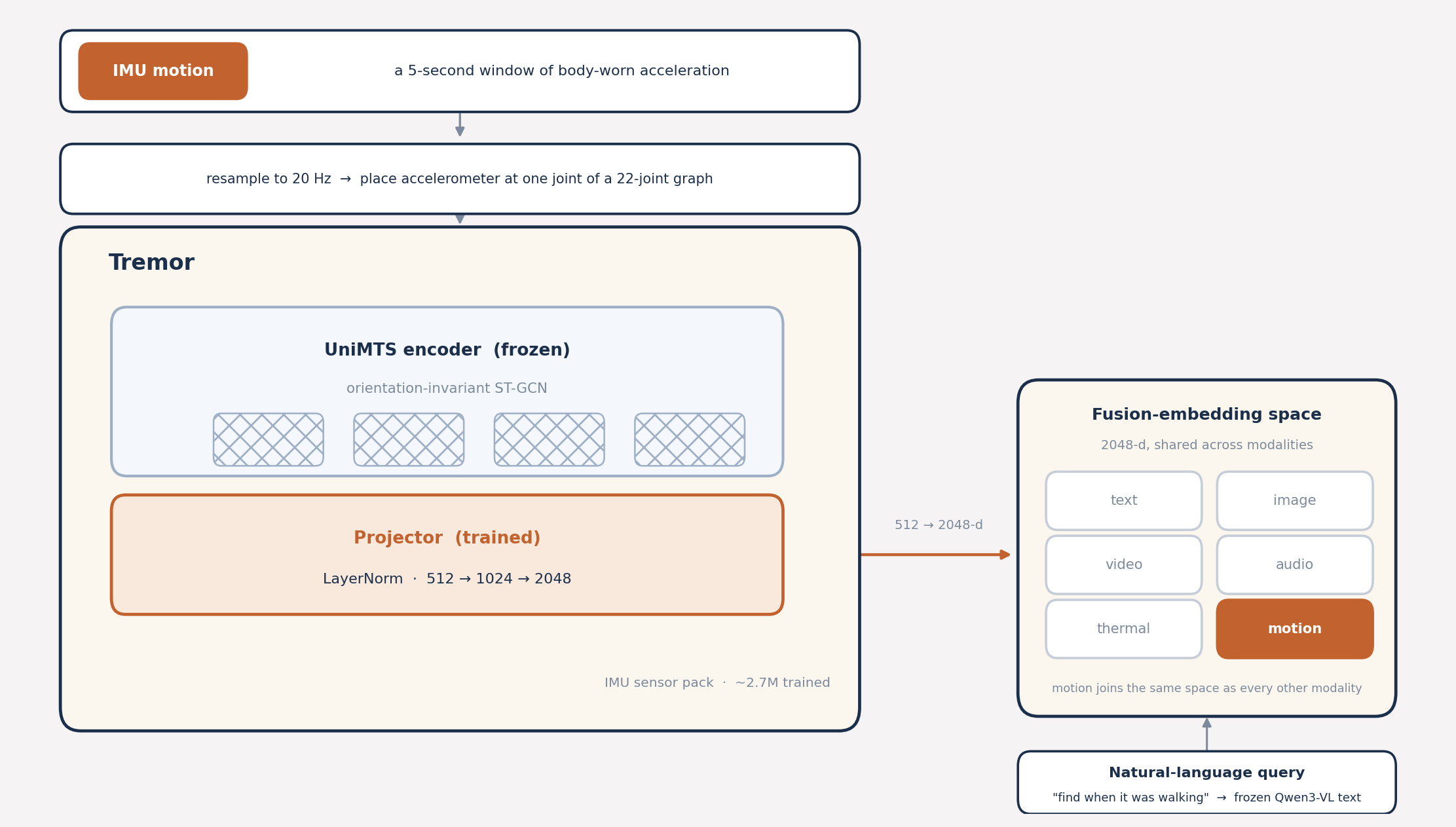
tremor brings body and device motion into the family. it reads accelerometer / imu signal and places it in the same text space fusion embedding 2 uses, so motion becomes something you can query with words.
only a small projector is trained; the motion encoder itself is frozen. it is a deliberately light attachment onto the shared space, and on held-out datasets it never trained on, it recognises activity at roughly three times chance.
how it works
a frozen unimts st-gcn accelerometer encoder produces motion features. a small trained projector maps those features into fe2's text space. the encoder does not move; only the projector learns.
a co-trained variant adds a motion↔video objective on synchronized egocentric data, teaching the projector to line motion up with what the camera saw at the same instant.
training data
only the projector is trained; the unimts encoder stays frozen, so the pack inherits its motion representation rather than learning one from scratch.
the co-trained variant adds a motion↔video objective on synchronized egocentric recordings. the encoder's unimts / amass lineage makes the pack cc-by-nc, non-commercial use only.
results
held-out zero-shot five-way activity recognition averages about 0.60 across datasets it never trained on (chance is 0.20). the co-trained variant lifts fine motion↔language matching from below chance to roughly 2.4× chance with no loss on the activity gate, and on a real unitree humanoid a "walking" query reaches average precision around 0.70. the strength is coarse motion (moving versus still, locomotion versus manipulation) while fine-grained activity semantics are still developing.
held-out zero-shot 5-way activity recognition (chance 0.20)
| dataset | accuracy |
|---|---|
| realworld | 0.74 |
| usc-had | 0.66 |
| dsads | 0.67 |
| utd-mhad | 0.32 |
| mean | ≈0.60 |
| unitree humanoid "walking" (AP) | ≈0.70 |
limitations
- —coarse motion is solid; fine activity semantics are still weak, as the spread across datasets shows.
- —the encoder is frozen, so the head inherits the motion representation it was given rather than learning its own.
- —licensed CC-BY-NC through its unimts / amass lineage, non-commercial use only.
usage
import torch
from transformers import AutoModel

model = AutoModel.from_pretrained(
    "EximiusLabs/fusion-embedding-2-tremor",
    trust_remote_code=True,
).eval()

# an accelerometer / imu window lands in the same 2048-d text space
motion = model.embed_motion("imu_window.npy")   # (T, channels)
query  = model.embed_text("walking across the room")

similarity = (motion * query).sum()
citation
@software{eximius_tremor_2026,
  author = {Eximius Labs},
  title  = {Tremor: an IMU / motion sense pack for the
            Fusion Embedding 2 space},
  year   = {2026},
  url    = {https://huggingface.co/EximiusLabs/fusion-embedding-2-tremor},
}
how it fits the family
tremor is the motion sense pack on the fe2 base: same shared space, a small projector, no retraining of the anchor.
its co-trained head is the motion path engram uses, which is what lets "how it moved" be a real query alongside "what it saw".
related models